


Title and description. Why they matter so much and how to write them properly
This article is 6 years old — prices and terms may have changed.

The title and the description are page meta tags that give users and search robots extra information about the content at a particular URL. Being able to write a title and a description properly is one of the important skills for a copywriter, an SEO specialist, a marketer and anyone who works with websites.
Read on and you will see that anyone can write meta tags that work for promotion.
The simplest way to do it is through the site's admin panel. If your blog, portal or shop runs on WordPress, use the Yoast SEO pluginfor working with meta tags.
What is this article about?
In this article we will go through several important questions:
-
What are the title and the description?
-
How many characters should each of a page's meta tags contain?
-
How do you write meta tags for every URL so as to speed up indexing and get more traffic?
-
What are the most common mistakes in writing titles and descriptions?
Title. What is it and why does it matter to a site?
The title is the heading of every page of a site. This tag is displayed in the results of every search engine and shows how relevant the page is to the main search query.

A missing title, or a duplicated one, can cost you an enormous amount of traffic.
When can the title become your secret weapon?
A page's tags play a particularly important role as soon as it reaches the top 10 or top 5 of the search results. Why? Recall the CTR (click-through rate) — the ratio of impressions to clicks. As it grows, the site will rise in the search results.
That is why there is a constant, fierce fight for attention. The main instruments of that fight are precisely the title and the description. People use special characters and numbers in them and capitalise words. And that is far from a complete list of the tricks.
The main advice on writing a title
-
A title must always be set on the page.
-
The optimum length of a title is 70 to 80 characters. Go beyond that and search engines will simply cut the text in the heading off.
-
Putting the site's name into the title is not compulsory. All search robots also take the text in the URL into account and react to the keywords it contains. Besides, the brand name can itself be a search query.
-
The queries included in the title have to be relevant to the page — related to its subject and content.
-
Page titles must not overlap even by 50%. Every unique title means more traffic and wider reach.
-
High-frequency queries are best placed at the start of the tag.
-
Make sure every word appears in the tag only once.
Follow these rules and you will be able to experiment with page tags. Bear in mind that changing the title alone can increase or reduce a page's traffic considerably. Sometimes after such experiments visits grow — or fall — several times over.
The description tag (a page's meta description): what it is, what it is for and how to write it
This tag contains a more detailed description of a site page. It is visible only in search results and on social media.
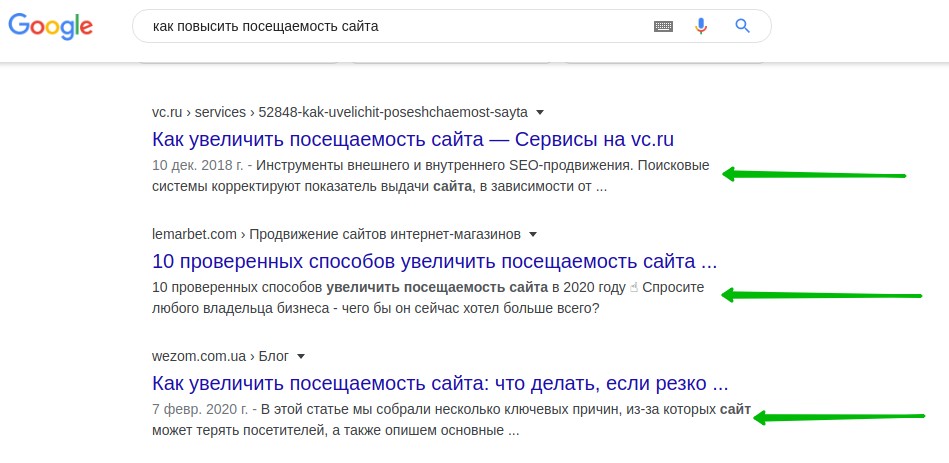
Like the title, the description tag is written in the page's code and must likewise be individual for every page. The easiest way to add a meta description is through the site's admin panel.
Advice on writing effective descriptions
-
The maximum length of a description tag is up to 300 characters. The optimum size for display in search results is 140 to 290 characters of text.
-
The description tag must contain keywords relevant to the subject in question.
-
Remember that a longer description has room for more relevant keywords. The main thing is that they really are relevant and that the description itself stays readable.
-
Like the title, the description has to include the main queries that match the page's content.
-
The description tag must be individual and substantial on every page. Make sure it never duplicates the title.
-
It is worth using calls to action in a description, along with the advantages of the product or service.
Search engines' requirements change, but the general recommendations we have listed will hold as long as Google exists in its current form.
Where do you find examples for writing meta tags?
That is a common question, and the answer is very simple: look at your competitors. Of course you should not copy their solutions outright, but it is worth working out the general principle behind their titles and descriptions.
Conclusions
Well-written meta tags are extremely important for SEO. Search engines periodically change their recommendations on the length of a title and a description. The rules we have given in this article hold regardless of Google's current updates.
The other side of the matter is the scope for experiments and variation. Depending on how you write a page's meta tags, its traffic can change by 30 to 50%, and sometimes several times over. That applies to a site's commercial pages as well as its informational ones (blog articles and so on).
Do not be afraid to experiment with meta tags. The main thing is to record the initial and final versions. That will let you go back to the starting state if the experiment does not produce the effect you wanted. Keep working to raise the site's CTR.
You will find that figure in the Google Search Consolemenu.
If successful experiments do increase your traffic, the load on the site will grow too. In that situation you will need more powerful hosting, or even a dedicated virtual server from Host4Biz. That will keep the site running and prevent the losses that come from it being unavailable.
Read our materials and grow your business online. And Host4Biz will keep your sites stored reliably.